Milestones: A Scalable System to Incentivize Everyday Payments
TEAM
Designer
Product Manager
3 Engineers
ROLE
User Research
Conceptualisation
Design
Dev Hand-Off
DURATION
2 Months
OVERVIEW
What is Milestone?
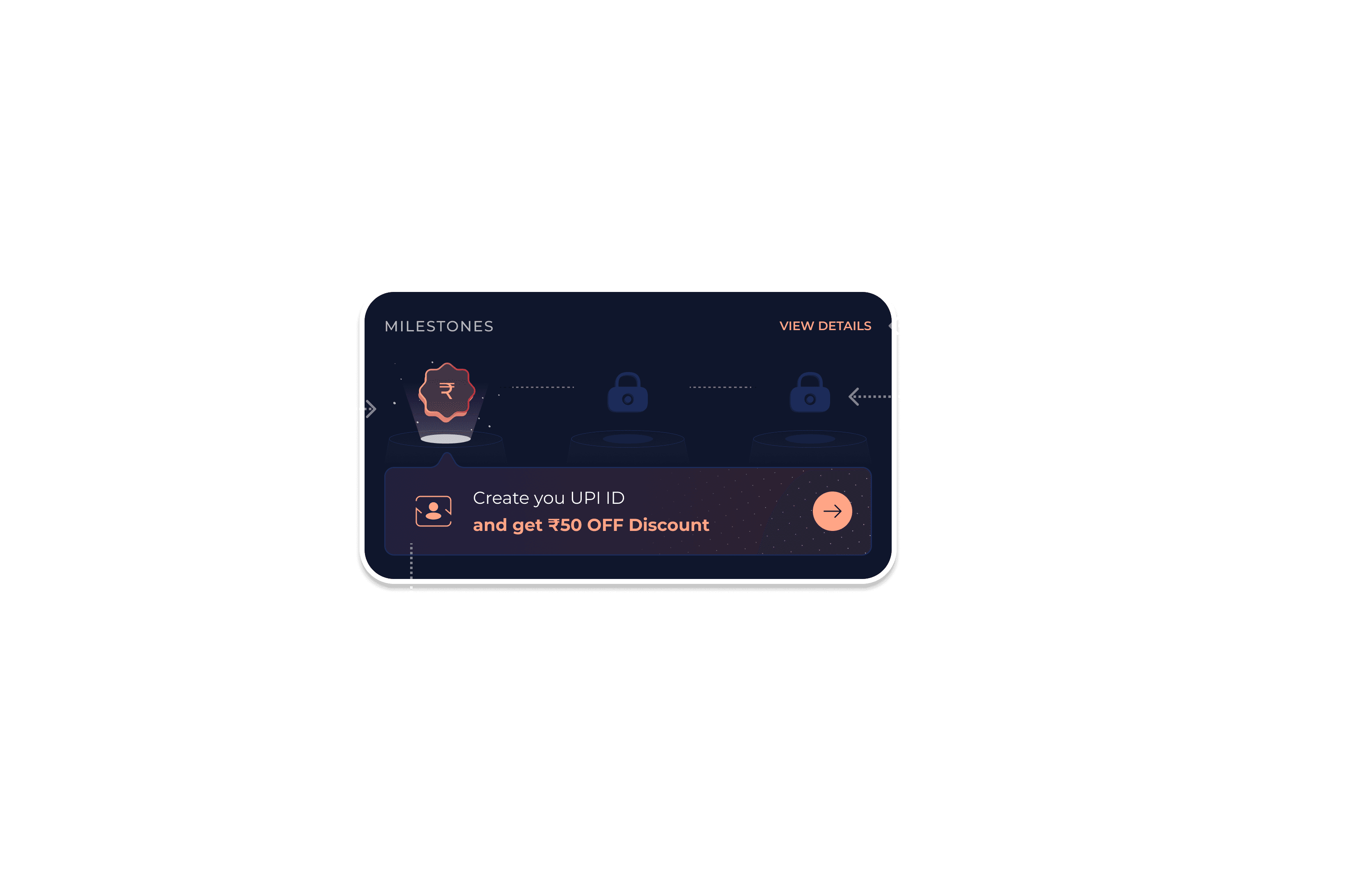
Milestones was first introduced to accelerate onboarding for Pay with Rewards. Users were rewarded for completing key actions like linking UPI or making their first Scan & Pay transaction. Activation improved, but usage dropped immediately after the first reward. The system solved the first transaction, not the habit. As TWID scaled merchant payments, Milestones needed to evolve from a one-time incentive into a system that could shape repeat payment behavior.
The goal shifted from driving activation to driving recurring merchant transactions at a lower acquisition cost. This project focuses on how Milestones was redesigned to scale beyond onboarding.
PROBLEM SPACE
Where the problem exist?
The existing Milestones system was built to trigger a first action, not sustained behavior.
It rewarded users for completing a single key step like linking UPI or making a Scan & Pay transaction. This drove a strong spike in activation. But once the reward was claimed, the system stopped. There was no progression, no next action, and no reason to return. Users optimized for the reward and exited immediately after.
As adoption increased, structural issues surfaced. Eligibility rules around refunds, partial payments, and time windows were unclear, creating confusion and mistrust. Some users learned to exploit these gaps by reversing transactions and still claiming rewards. The system lacked visibility, guardrails, and a way to communicate edge cases.
Milestones proved demand but could not scale. Without a clear journey, progress tracking, or behavioral controls, it failed to turn first-time rewards into repeat payment behavior.
RESEARCH
To build a solution, we explored the ecosystem & Existing solution deeply
We studied products that consistently drive repeat behavior at scale. We looked at habit-forming systems across apps like Duolingo, Sweatcoin, and CRED, focusing on how they move users from a single action to ongoing engagement. We also observed organic user behavior around Milestones offers, including how users shared and reacted to progress-based rewards.
Key insights emerged: Users stay engaged when rewards are tied to visible checkpoints rather than one-time goals. Breaking milestones into phases makes progress feel real and achievable. If progress is not visible at the moment of action, it does not convert.
Hypothesis: If Milestones were redesigned as a multi-checkpoint journey with clear, visible progress and consistent eligibility rules, users would stay engaged longer and transact more frequently.
Constraints and Trade-offs
Milestones had to evolve without disrupting the core product. The team could not introduce major changes to primary flows or slow down parallel roadmaps. The system needed to layer on top of existing experiences like Offers, Bill Payments, UPI, and Rewards, not compete with them.
There was also a structural requirement. Milestones had to feel native to the app while remaining flexible enough for growth teams to run experiments quickly. Any solution that required heavy engineering effort or repeated rebuilds was off the table. The direction was clear. Lightweight in surface area, strong in impact.
Trade-off:
Early explorations included rich, contextual nudges that adapted in real time based on user progress. These were designed to guide users more actively toward completion. Due to technical constraints around dynamic content delivery and real-time segmentation, these nudges were deprioritized for launch. The core milestone framework shipped first, with space left to layer this behavior in future iterations.
OBJECTIVE
Turn rewards into a repeat payment habit
Increase repeat usage of reward points and grow daily UPI GMV by designing Milestones that guide users toward frequent transactions, clearly communicate progress and eligibility, and support recurring merchant payments without increasing acquisition cost.
IMPACT
For Product and Business
Milestones created a structured retention lever around everyday payments. It shifted repeat usage from chance to design, giving the team a scalable way to guide behavior and run incentive experiments.
While GMV uplift was a visible outcome, the real impact was foundational. Milestones enabled long-term habit formation and faster learning, solving for retention where projections were uncertain but critical.
For Users
Milestones gave users clarity and momentum. Routine payments now came with visible progress and a clear payoff.
Transparent rules and progress states reduced friction and built trust, leading to higher engagement among users who participated in milestones compared to those who didn’t.
View Figma For Detailed Designs
FINAL SOLUTION
1. Milestone Construct Design
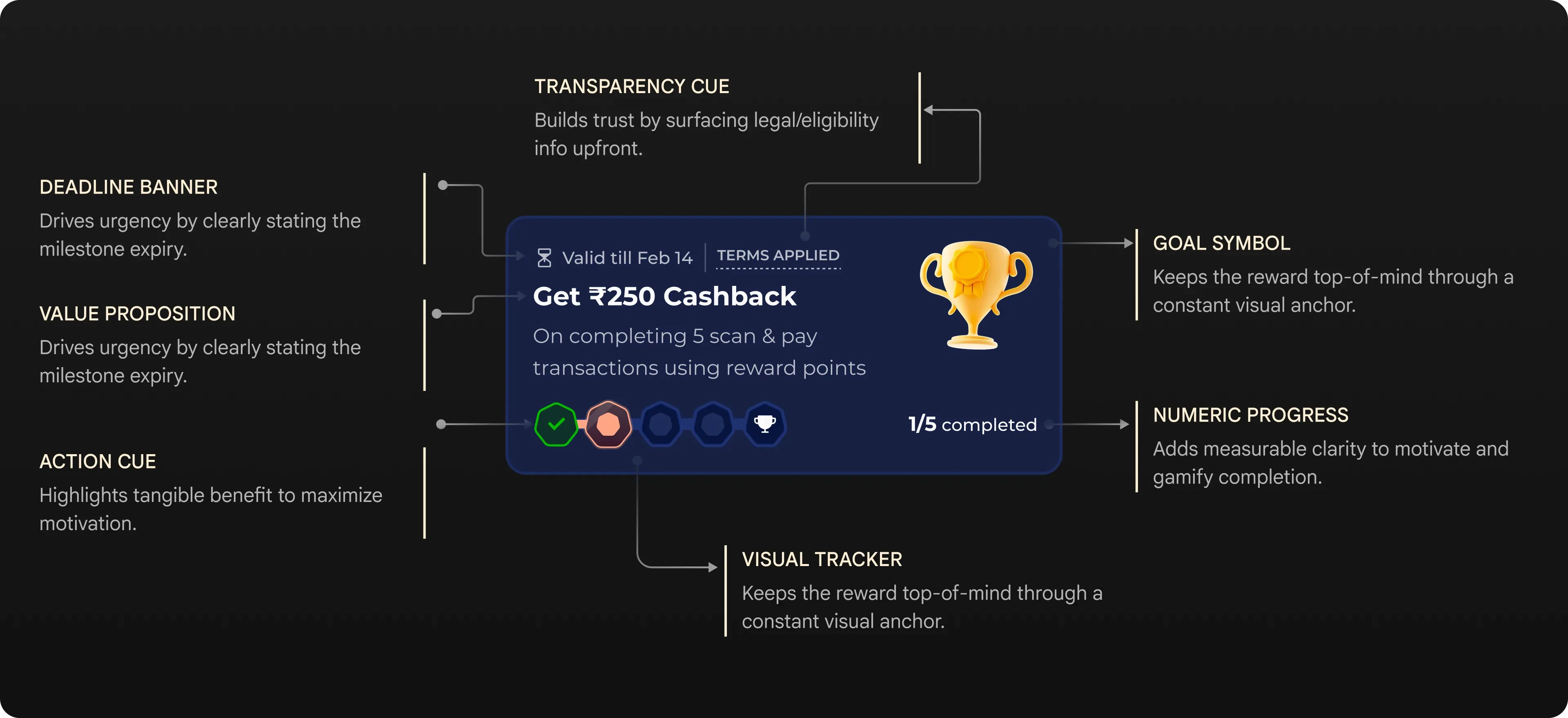
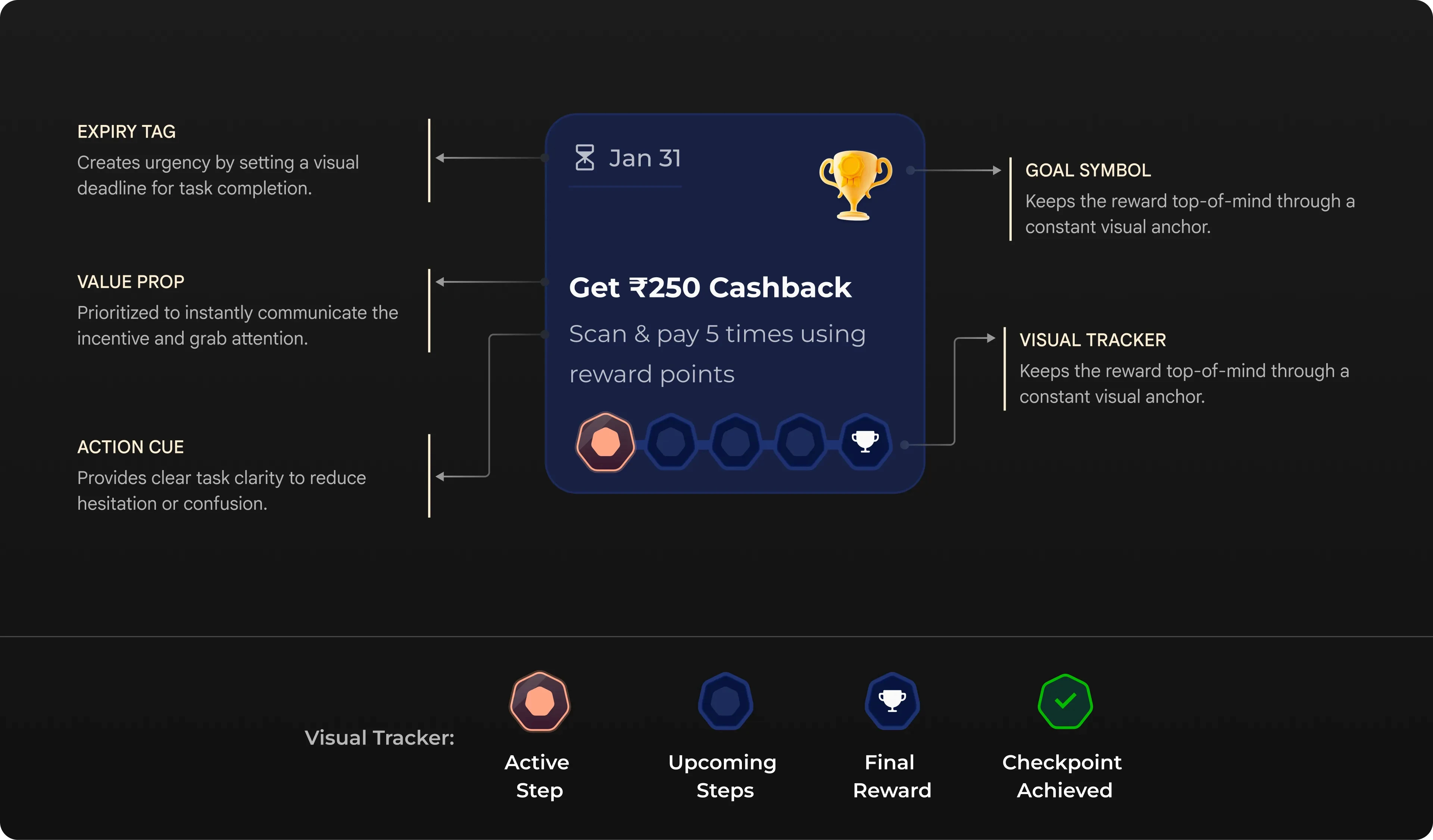
The Milestone construct was designed to make progress visible at a glance. Each milestone combines a clear value proposition with a precise action cue, so users immediately know what they will earn and what action moves them forward. There is no interpretation required.
Progress is shown through a visual tracker with checkpoints, reinforced by a numeric tracker on the detail view. This turns effort into something accumulative instead of binary. An always-visible expiry tag introduces urgency, while surfaced eligibility and terms remove ambiguity around refunds and edge cases.
A consistent goal symbol acts as a visual anchor across the app. Together, these components guide users on what to do next, how far they’ve come, and why it’s worth continuing.
2. Milestones Core Loop
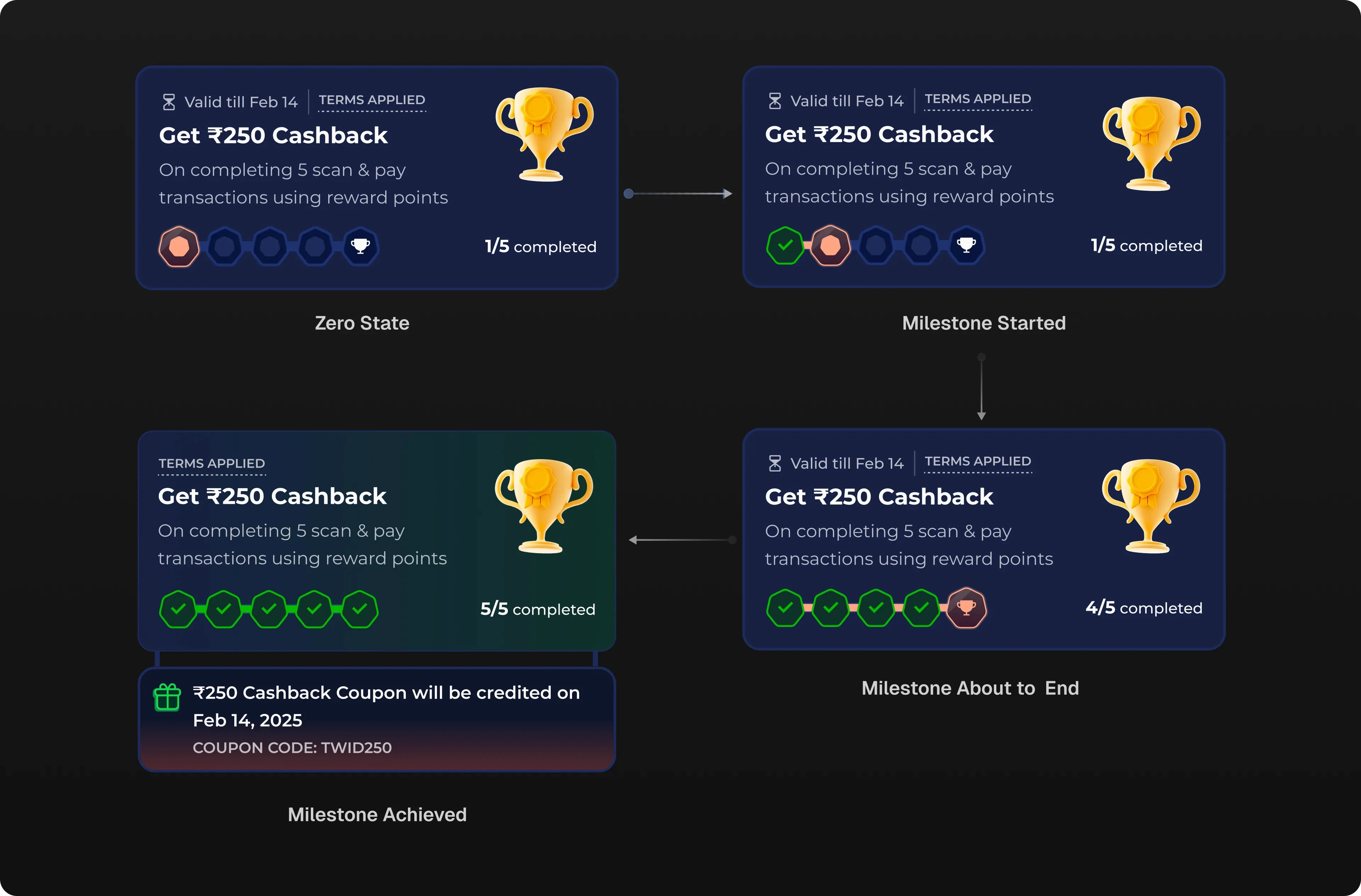
The core flow was designed to make progress unmistakable.
Each milestone moves through clear states, from zero progress to completion, using progress rings and checkpoint icons to show a linear path. Every completed step flips to a checkmark, confirming that the action counted and encouraging the next one.
Numeric cues like “4/5 completed” appear as users get closer to the reward, introducing urgency at the right moment. Reward previews stay visible throughout, keeping the outcome top of mind.
The layout stays consistent across states. Only color and icon states change. This keeps the system familiar while subtly guiding focus as users move forward.
Together, these signals ensure users always know where they are and what comes next.
3. Making Progress Visible Before the Transaction
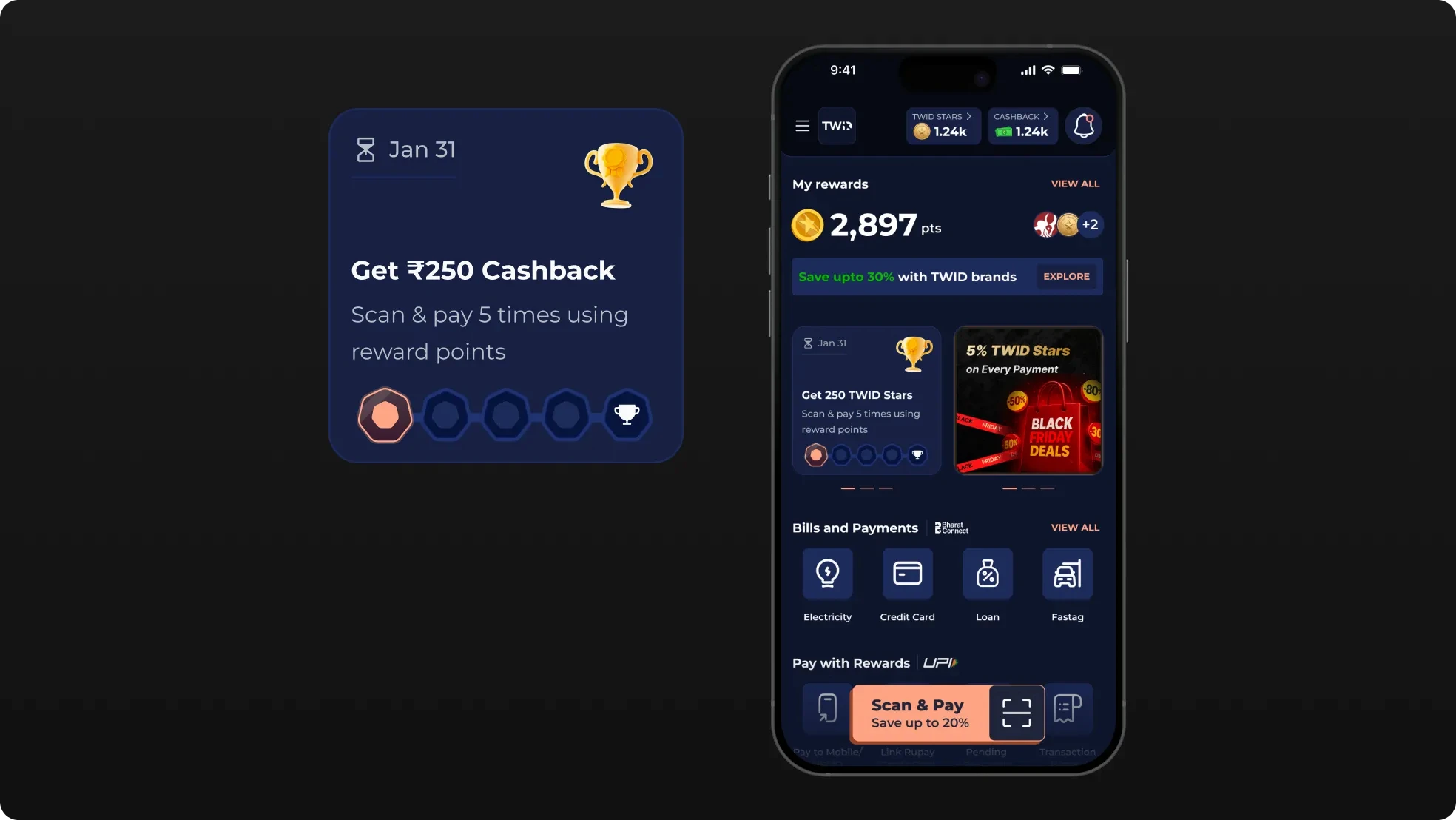
Milestones were surfaced directly on the homepage. Active milestones appear upfront, showing current progress at a glance. This anchors the system in the daily experience instead of hiding it behind secondary screens.
The homepage acts as a reminder loop. Users see unfinished progress before they transact, not after. Why this mattered: If progress isn’t visible at the moment of intent, it doesn’t influence behavior. Placement drives recall.
4. Milestone Listing with Clear State Feedback
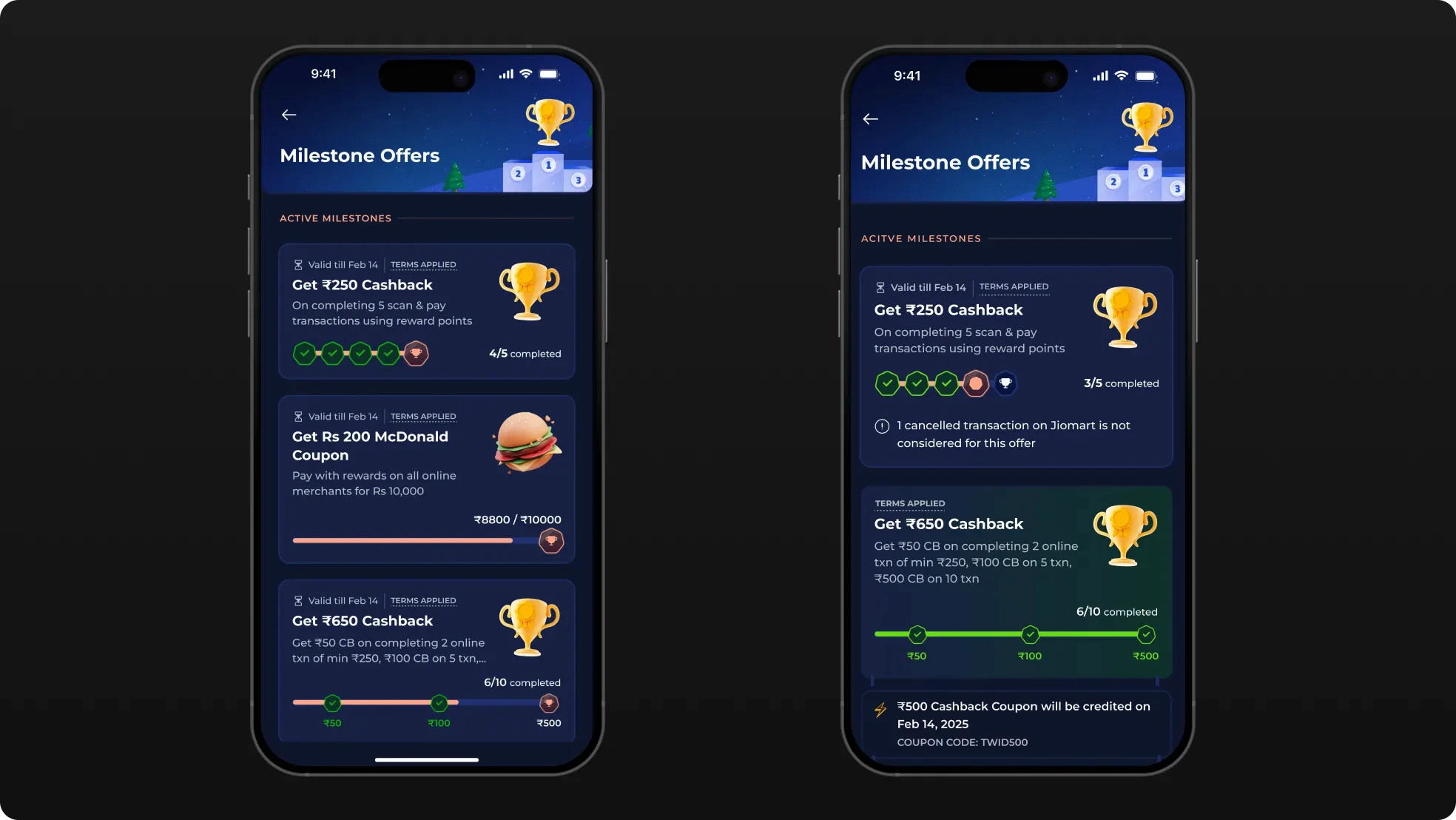
Each milestone is designed to communicate its state instantly. Active, completed, expired, and disqualified milestones are visually distinct. Progress rings, numeric counters like “4/5 completed,” and reward previews clearly show where the user stands at any moment.
Status is understood at a glance. Users do not need to read rules or open terms to know whether a milestone is valid or progressing. This clarity reduced confusion, limited misuse, and strengthened trust in the system.
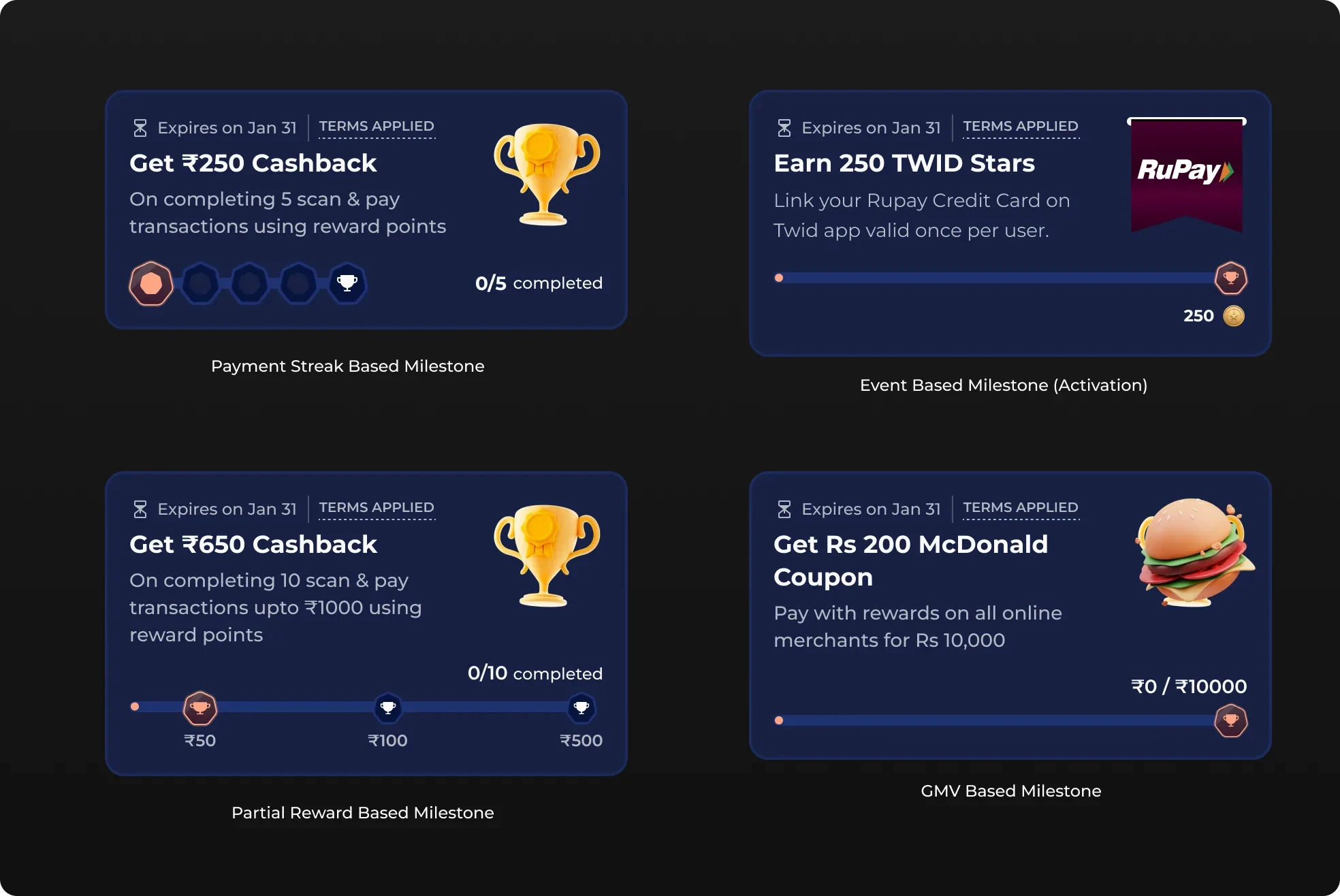
Types of Milestones
Milestones were designed to be flexible by default.
The system supports different reward logics based on the behaviour being targeted.
Transaction-based milestones track the frequency of eligible actions.
GMV-based milestones tie rewards to total spend using reward points.
Partial payout milestones unlock rewards in stages to extend engagement across multiple transactions.
This structure allows growth teams to target frequency, spend, or intent without changing the core experience.